POCUS — point-of-care ultrasound
Ultrasound brought to the patient, at the moment of the clinical decision — not the patient brought to the exam. A workflow shift that reshaped practice in urgent care, emergency medicine, and critical care.
Categories
Urgent and emergency protocols
Standardized sequences that guide rapid workup in high-pressure scenarios.
FAST
Focused Assessment with Sonography for Trauma — targeted search for free fluid in body cavities in trauma patients.
eFAST
An extension of FAST with pleural and lung assessment, broadening the workup to pneumothorax and pleural effusion.
Lung protocol
A systematic sequence of thoracic windows to characterize A-lines, B-lines, and consolidations.
Pneumothorax assessment
Assessment of lung sliding, lung point, and associated signs in the emergency setting.
Pleural effusion
Bedside quantification and characterization, guiding thoracentesis when indicated.
Pulmonary edema
Recognizing the diffuse B-line pattern as a decision-support tool in acute dyspnea.
Shock
Focused hemodynamic assessment algorithms — IVC, global cardiac function, and cause-finding.
Focused cardiac assessment
Basic windows for global function, pericardial effusion, and signs of right-heart strain.
Cardiac arrest
The role of ultrasound in investigating reversible causes during resuscitation, without interrupting compressions.
Guided vascular access
Real-time guided puncture for difficult central and peripheral venous access.
Focused abdominal assessment
Search for free fluid and abdominal warning signs in the acute patient.
Trauma assessment
Integration of the protocols above into a decision flow for the polytrauma patient.
Technical content intended for health professionals in training or practice. POCUS protocols require supervised training before independent application in clinical practice.
POCUS cases
See all →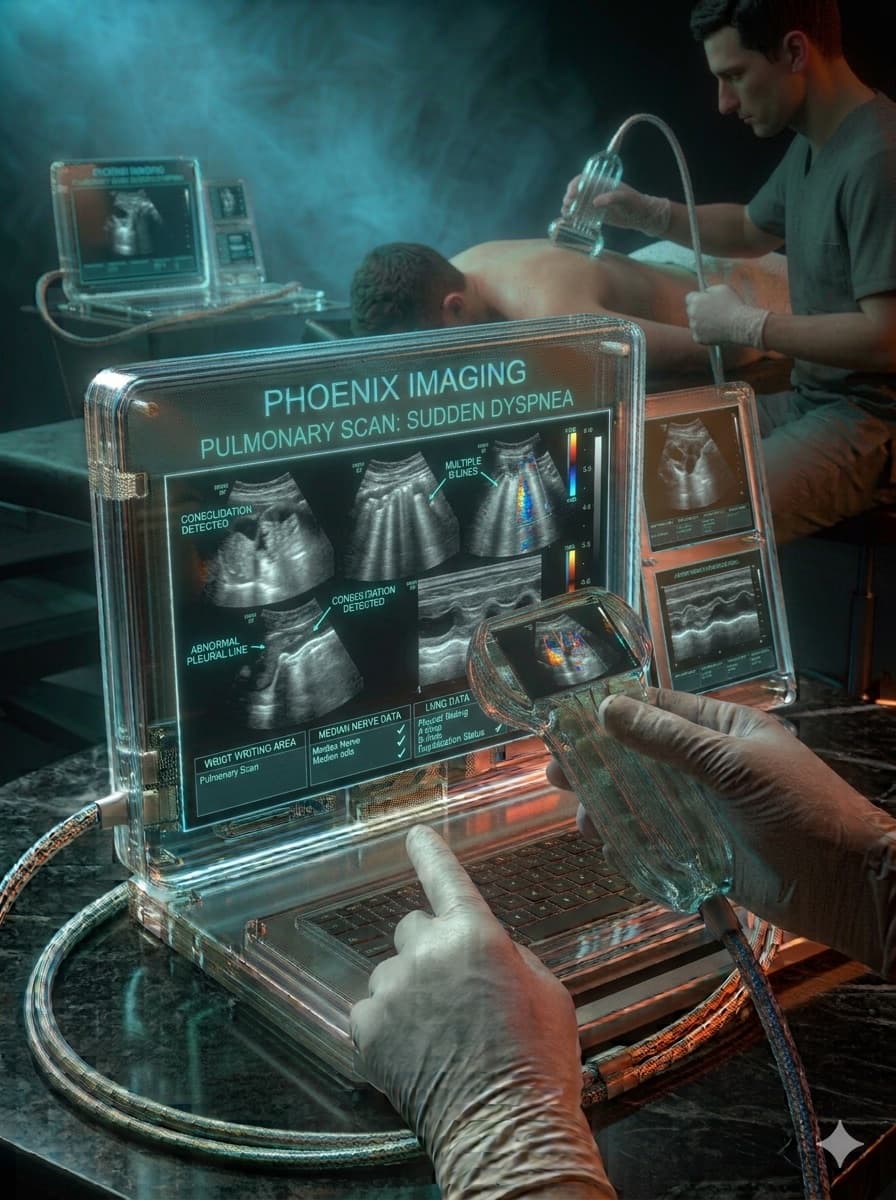
Frequently asked questions
What is POCUS and how is it different from a traditional ultrasound?
POCUS (Point-of-Care Ultrasound) is bedside ultrasound performed by the treating physician to answer a focused, immediate clinical question (e.g., is there free fluid? is there a pneumothorax?) — unlike a full diagnostic ultrasound performed in radiology, which systematically investigates multiple findings.
Who can use POCUS in clinical practice?
Emergency physicians, intensivists, anesthesiologists and other trained treating physicians use POCUS as an extension of the physical exam. It does not replace a full diagnostic ultrasound when that is needed.
Do POCUS protocols like FAST and eFAST replace other imaging exams?
No. Protocols like FAST and eFAST are rapid screening tools in trauma and emergency care, to support immediate decisions — relevant findings usually require confirmation or follow-up with additional imaging, depending on the clinical picture.
Does POCUS require specific training to be used safely?
Yes. Even though the equipment is accessible, correct interpretation requires structured training, supervised practice and understanding each protocol's limits — which is why hands-on courses with real cases matter.
Want content like this before anyone else?
Join the Ultrassom 360° VIP list and get free lessons, commented clinical cases, and news before everyone else.